

- Home /
- Blog List /
- What Size Generator Do You Need to Run a Welder? Key Tips to Match Your Power Needs
Shop Now
- Welding Consumables
- Welding Torches & Torch Spares
- Welding Machines
- Plasma & Cutting Machines
- Welding Machine Spare Parts & Accessories
- Welding Fume Extraction Equipment
- Gas Welding Equipment
- Welding Abrasives
-
Welding Safety Gear
- Welding Helmets
-
Welding Helmet Spares
- Speedglas Spares
- 3M Spares
- Betaweld Spares
- Cigweld Spare Parts & Accessories
- Flip Front Helmet Spares
- Jackson Spares & Accessories
- Lincoln Electric Spare Parts & Accessories
- Miller Spares & Accessories
- RPB Spares
- Servore Spares
- Unimig Spare Parts & Accessories
- Weldclass Spares & Accessories
- Miscellaneous Helmet Lens
- Welding Gloves
- Protective Workwear
- Welding Blankets
- Welding Screens & Curtains
- Ear Protection
- Eye Protection
- Face Protection
- Hand Protection
- Head Protection
- Respiratory Protection
- Sun Protection
- Hydration Products
- Fire Blankets
- Prestart Books
- Safety Signage
- Safety Tags
- Hazard Tape
- Welding Accessories
- Pipe Welding Equipment
-
Cutting & Drilling
- Bandsaws
- Bandsaw Blades
- Bandsaw Accessories
- Coldsaws
- Core Drills & Accessories
- Cutting & Milling Blades
- Diamond Blades
- Drill Bits
- Holesaws
- Magnetic Base Drills
- Metal Working Lubricants
- Pipe Bevelling
- Pipe Cutting Equipment
- Pipe Tee Pulling Kits
- Pipe Threading Machines
- Plasma Table Water Additives
- Punching Machines
- Welding Merchandise
- Gift Cards
- Clearances
-
Hire
- Hire Equipment
- Hire Heating Equipment
- Hire Degausing Equipment
- Hire Welding Automation
- Hire a Welding Positioner
- Hire a Turning Roller
- Hire a Diesel Welder
- Hire a Wirefeeder
- Hire a Multi-Process Welder
- Hire Accessories
- Hire a MIG Welder
- Hire a TIG Welder
- Hire a Stick Welder
- Hire a Plasma Cutter
- Hire a Weld Cleaner
- Hire a Stud Welder
What Size Generator Do You Need to Run a Welder? Key Tips to Match Your Power Needs
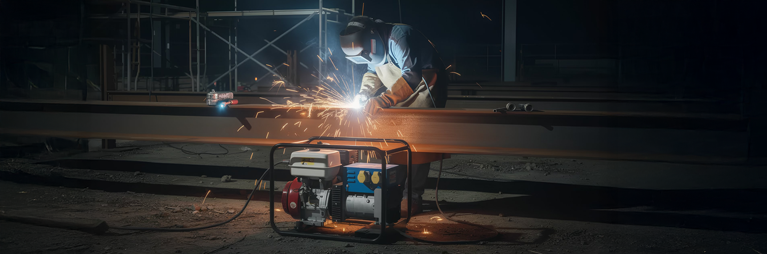
Choosing the wrong generator size for a welder can shut down your work just when you need power most. Many welders struggle to match their machine's power needs with a generator that can handle the job.
This guide breaks down welding machine power requirements and shows you how to choose a generator that keeps your welder running smoothly, whether on-site or in your workshop.
Understanding Welding Power Requirements
Different Welders, Different Power Needs
The generator size needed to run a welder depends on the welder's amperage, with a general rule of thumb being a minimum of 7 kVA (5 kW) for up to 130A welders, scaling up to 40 kVA (32 kW) for a 400A welder. A good rule of thumb is to select a generator with a slightly higher wattage rating than the welder's input requirements to avoid overloading and ensure stable power, especially with inverter welders. Always consult your welder's manual for specific input power needs.
|
Welder Amperage |
Minimum Generator Size |
Recommended Generator Size |
|---|---|---|
|
Up to 130A |
6 kVA (5 kW) |
7+ kVA (5 kW) |
|
140A - 160A |
7 kVA (5.5 kW) |
8+ kVA (6.5 kW) |
|
180A - 200A |
8 kVA (6.5 kW) |
10+ kVA (8 kW) |
|
250A |
13 kVA (10.5 kW) |
15+ kVA (12 kW) |
|
300A |
15 kVA (12 kW) |
20+ kVA (16 kW) |
The Critical Starting Wattage
Your generator must handle both running and starting wattage. Starting wattage can be 2-3 times higher than running wattage. This surge happens when you first pull the trigger on your welder and is a common reason why undersized generators fail.
Sizing Your Generator Correctly
The 30% Rule for Welding
For reliable welding power, your generator should be rated at least 30% higher than your welder's maximum power draw. This buffer protects against power fluctuations and extends generator life.
Real-World Examples
For a 140A welder drawing about 4,000 watts, you'll need at minimum a 5,200-watt generator. For a 200A industrial welder drawing 8,000 watts, look for a 10,400-watt generator or larger.
Generator Types for Welding
Inverter vs. Conventional Generators
Inverter generators produce clean power with stable sine waves, making them perfect for sensitive welding equipment. Conventional generators are cheaper but may cause fluctuations that affect weld quality.
Portable Options for Field Work
Portable generators in the 5,000-7,000 watt range work well for most STICK and small MIG welders. For bigger jobs, trailer-mounted 10,000+ watt generators provide the necessary power for industrial welding equipment.
Welding and Generator Compatibility
Voltage Considerations
Most welders run on 220-240V, but smaller units may use 110-120V. Make sure your generator delivers the correct voltage for your specific welder model.
Generator Features Welders Need
Look for generators with:
-
Multiple outlets (both 120V and 240V)
-
Circuit breakers
-
Low THD (Total Harmonic Distortion) under 6%
-
Fuel gauge
-
Electric start
Common Mistakes to Avoid
Underestimating Power Needs
The biggest mistake is buying too small. When in doubt, go bigger with your generator size for welding applications.
Ignoring Altitude Effects
Generators lose about 3.5% power capacity for every 1,000 feet above sea level. Factor this in for high-altitude welding jobs.
Practical Buying Guide
Budget Options
For hobbyists with small 110V welders, a 4,000-5,000 watt portable generator works well for basic STICK welding and light MIG work.
Mid-Range Solutions
Professional mobile welders should invest in 7,000-8,000 watt generators with electric start and low THD for reliable all-day operation.
Professional Grade
Heavy industrial welding requires 10,000+ watt generators with 240V capability and fuel-efficient engines for extended run times.
Maintenance Tips for Welding Generators
Proper Load Management
Run your generator at 50-75% capacity for optimal performance. Constantly running at maximum output shortens engine life.
Regular Service Schedule
Change oil every 50-100 hours of operation. Check spark plugs, air filters, and fuel filters monthly when used regularly for welding power needs.
Final Recommendations
Choosing a generator for welding doesn't need to be complicated. Match your welding amperage to the right generator wattage, add 30% for safety, and select a model with clean power output. This simple formula ensures your welder performs at its best, even in remote locations.
Remember that what size generator to run a welder depends on your specific equipment and welding requirements. When in doubt, consult your welder's manual for exact power specifications before making your final generator purchase.