

Shop Now
-
Welding Consumables
-
MIG Welding Wires
- Mild Steel MIG Wires
- Stainless Steel MIG Wires
- Duplex & Super Duplex MIG Wires
- Low Alloy MIG Welding Wires
- Flux Cored MIG Wires
- Flux Cored Seamless MIG Wires
- Flux Cored Self Shielded MIG Wires
- Flux Cored Stainless Steel Wires
- Flux Cored Duplex MIG Wires
- Aluminium MIG Wires
- Metal Cored MIG Wire
- Metal Cored Seamless MIG Wires
- Bronze MIG Wires
- TIG Welding Rods
- Welding Electrodes
- Gouging Carbons
- Hardfacing Wires
- Sub Arc Wires
- Sub Arc Flux
- Brazing Rods
- Brazing Fluxes
- Soldering Products
-
MIG Welding Wires
- Welding Torches and Torch Spares
-
Welding Machines
- Machine Bundles
- MIG Welding Machines
- TIG Welding Machines
- STICK Welders
- Multi-Process Welders
- Battery Welders
- Laser Welders
- Laser Cleaners
- Wire Feeders
- Sub Arc Welding Machines
- Stud Welding Machines
- Engine Driven Welding Machines
- Weld Cleaning Machines
- Welding Automation Machines
- Heating Equipment
- Tungsten Grinders
- Tungsten Feeders
- Plasma & Cutting Machines
-
Welding Machine Spare Parts
- Welding Trolleys
- Alfra Spare Parts
- Betaweld Spare Parts
- Bug-O Spare Parts
- Cougartron Spare Parts
- Excision Spare Parts
- Fronius Spare Parts
- Geiger Spare Parts
- Hypertherm Spare Parts
- Kemppi Spare Parts
- Koike Spare Parts
- Lincoln Electric Spare Parts
- Miller Spare Parts
- Neutrix Spare Parts
- Rex Spare Parts
- Taylor Spare Parts
- Unimig Spare Parts
- Von Arx Spare Parts
- Weldmax Spare Parts
- Welding Fume Extraction Equipment
- Gas Welding Equipment
- Welding Abrasives
-
Welding Safety Gear
- Welding Helmets
-
Welding Helmet Spares
- Speedglas Welding Helmet Spares
- 3M Spares
- Betaweld Welding Helmet Spares
- Cigweld Welding Helmet Spares
- Flip Front Helmet Spares
- Jackson Welding Helmet Spares
- Lincoln Welding Helmet Spares
- Miller Welding Helmet Spares
- RPB Welding Helmet Spares
- Servore Welding Helmet Spares
- Unimig Welding Helmet Spares
- Weldclass Welding Helmet Spares
- Miscellaneous Helmet Lens
- Welding Gloves
- Protective Workwear
- Welding Blankets
- Welding Screens and Curtains
- Ear Protection
- Eye Protection
- Face Shields
- Hand Protection
- Head Protection
- Welding Respiratory Gear
- Sun Protection
- Hydration Products
- Fire Blankets
- Prestart Books
- Welding Safety Signages
- Safety Tags
- Hazard Tapes
-
Welding Accessories
- Air Tools
- Power Tools
- Welding Aids
- Welding Tables
- Welding Cables
- Welding Leads
- Electrical Power Supplies
- Welding Clamps
- Clamp Accessories
- Earth Clamps
- Welding Cleaning Equipment
- Welding Chemicals
- Arcair Gouging
- Lifting Accessories
- Hammers
- Manual Arc Accessories
- Weld Measuring
- Weld Testing Products
- Wire Brushes
- Pipe Welding Equipment
-
Cutting & Drilling
- Bandsaws
- Bandsaw Blades
- Bandsaw Accessories
- Cold Saws
- Core Drills
- Cutting Blades
- Diamond Blades
- Drill Bits
- Holesaws
- Magnetic Base Drills
- Metal Working Lubricants
- Pipe Bevelling Machines
- Pipe Cutting Equipment
- Tee Pulling Kits
- Pipe Threading Machines
- Plasma Table Water Additives
- Hydraulic Punching Machines
- Welding Merchandise
- Gift Cards
- Welding Clearances
-
Welding Equipment Hire
- Hire Equipment
- Hire Heating Equipment
- Hire Degausing Equipment
- Hire Welding Automation
- Hire a Welding Positioner
- Hire a Turning Roll
- Hire a Diesel Welder
- Hire a Wirefeeder
- Hire a Multi-Process Welder
- Hire Welding Accessories
- Hire a MIG Welder
- Hire a TIG Welder
- Hire a Stick Welder
- Hire a Plasma Cutter
- Hire a Weld Cleaner
- Hire a Stud Welder
How Does a Plasma Cutter Work?
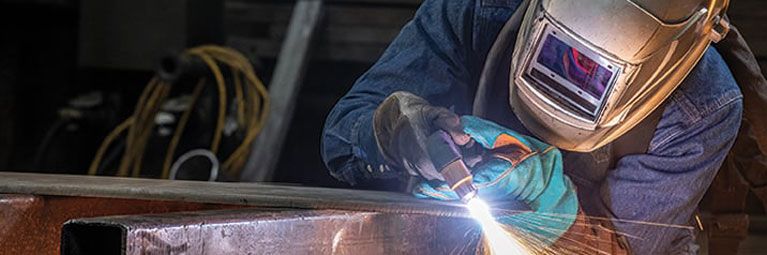
Have you ever wondered what a plasma cutter is? In this guide, we'll cover everything you need to know about plasma cutting.
What is a Plasma Cutter?
A plasma cutter is a machine that uses compressed gas to create an electrically conductive channel of ionized particles called plasma. Plasma is what you see in lightning and it's extremely hot, reaching temperatures of 20,000 degrees Celsius (40,000 degrees Fahrenheit). This makes a plasma cutter a clean and precise method for cutting metals like copper, brass, aluminum, and steel with little to no resistance. Modern plasma cutters often use a pilot arc between the electrode and nozzle to ionize the gas, which generates plasma before the arc transfer.
How Do Plasma Cutters Work?
When you pull the trigger on your plasma cutter, compressed gas flows through the machine and out the torch. Along the way, this gas is ionized and forced thru a device that creates a high-speed vortex. The other important thing that happens is some sort of starting mechanism is activated. This starting mechanism is what ionizes the gas. This ionized vortex of gas creates the pilot arc. The pilot arc passes through the tip or nozzle orifice before eventually contacting the metal. When this happens the pilot arc transfers to the plate and becomes a cutting arc.
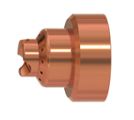
Plasma cutter drag tips or drag shields do nothing more than allow you to drag your torch on the metal that you are cutting. For this to happen, this drag tip must be electrically isolated from the torch circuitry.
What is a Plasma Cutter Drag Tip?
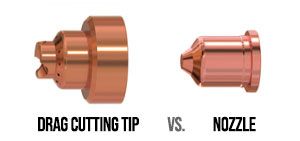
A drag tip is basically a copper shield that attaches to the front of the torch ahead of the nozzle. This shield electrically isolates the nozzle from the metal work piece to eliminate a common phenomenon known as double arcing so you can drag your torch directly on the workpiece without it sticking. There are a couple of advantages to drag cutting. The first is, it makes things easier for the operator. You don't have to worry about having a steady hand. You can simply drag the torch along a straight edge or template. In most cases, you should wind up with a more accurately cut piece. Drag cutting also helps to increase consumable life as metal spatter and blow back isn't as much of a problem. Hypertherm offers shielded cutting technology up to 200 amps with a hand torch.
What are Plasma Cutter Drag Tips Used For?
A drag tip is used on the end of your plasma cutter to cut through thin metals easily. Drag tips are great for cutting sheet metal, even at low amp rates. You can draw straight lines or follow patterns easily while dragging along the surface of your metal while having total control over how fast things move.
Industries that use plasma cutters with drag tips include:
• Manufacturing
• Construction
• Automotive
• Machinery
• Electrical
What is the Difference between a Drag Tip and a Nozzle?
The major difference between the nozzle and a drag tip is that the nozzle is sometimes a part of the electrical circuit while the drag tip never is. When the nozzle is part of the circuit it is the ground that the arc wants to attach to. After the arc has been established and transferred to the metal, the purpose of the nozzle is to shape and focus the arc. Both pieces are plasma cutter consumables, but it’s important to note that they are not the same thing.
Using Plasma Cutter Drag Tips
To use a drag tip, you first need to purchase a drag tip and then attach it to your plasma cutter’s torch. Next, you’ll want to secure your metal work piece, turn on the gas and plasma cutter and set your desired current.
If your machine uses a pilot arc, hold the tip about an inch away from the workpiece. Once ready, pull the trigger and drag your torch along the workpiece until your cut is complete. Remember that drag tips are consumable parts, so be prepared to change them out as needed.
What is Drag Cutting?
Drag cutting is a plasma cutting process that uses drag tips to shape metal. This method is mainly used for thin metals, like sheets, and provides more control than other methods like stand-off cuts. In addition, the process results in a smooth edge that is free from burrs and other inconsistencies.
Drag cutting with plasma works by having the tip of your cutter touching the material you're working on, then moving it slowly across its surface while maintaining a constant speed and height. This will create an even, straight cut. You can drag the torch along in a straight line or make curvy patterns.
Although drag cuts require patience and practice since you're drawing out each line while cutting through the material with speed and precision, many people find drag cutting easier than holding a stand-off.
Common Mistakes When Using a Drag Tip
Drag cutting using a plasma cutter drag tip is fairly easy to learn. The most common mistake new operators make when learning to drag cut is moving the torch too quickly so that the plasma arc doesn’t have enough time to actually cut through the workpiece. A quality cut has lines on the cut face that angle slightly back from the travel direction at around 15-30 degrees, revealing a lot about correct and incorrect speeds. These lines are called lag lines. Be patient while learning how to use this type of plasma cutter tip, especially when dealing with thicker metals. And always make sure to care for your consumables.
Buying Plasma Cutter Drag Tips
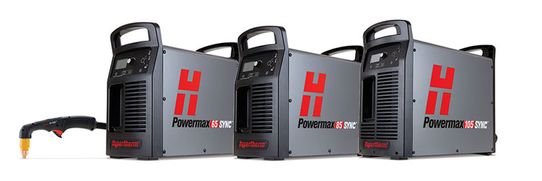
We trust this guide has helped you gain a better understanding of plasma cutting and how it works. If you’re looking towards the next step of purchasing a plasma cutter, we invite you to explore our Hypertherm range of plasma cutters or contact us for further guidance.
Source: Hypertherm.com