

Shop Now
- Welding Consumables
- Welding Torches & Torch Spares
- Welding Machines
- Plasma & Cutting Machines
- Welding Machine Spare Parts & Accessories
- Welding Fume Extraction Equipment
- Gas Welding Equipment
- Welding Abrasives
-
Welding Safety Gear
- Welding Helmets
-
Welding Helmet Spares
- Speedglas Spares
- Betaweld Spares
- Cigweld Spare Parts & Accessories
- Flip Front Helmet Spares
- Jackson Spares & Accessories
- Lincoln Electric Spare Parts & Accessories
- Miller Spares & Accessories
- RPB Spares
- Servore Spares
- Unimig Spare Parts & Accessories
- Weldclass Spares & Accessories
- Miscellaneous Helmet Lens
- Welding Gloves
- Protective Workwear
- Welding Blankets
- Welding Screens & Curtains
- Ear Protection
- Eye Protection
- Face Protection
- Hand Protection
- Head Protection
- Respiratory Protection
- Sun Protection
- Hydration Products
- Fire Blankets
- Prestart Books
- Safety Signage
- Safety Tags
- Hazard Tape
- Welding Accessories
- Pipe Welding Equipment
-
Cutting & Drilling
- Bandsaws
- Bandsaw Blades
- Bandsaw Accessories
- Coldsaws
- Core Drills & Accessories
- Cutting & Milling Blades
- Diamond Blades
- Drill Bits
- Holesaws
- Magnetic Base Drills
- Metal Working Lubricants
- Pipe Bevelling
- Pipe Cutting Equipment
- Pipe Tee Pulling Kits
- Pipe Threading Machines
- Plasma Table Water Additives
- Punching Machines
- Welding Merchandise
- Gift Cards
- Clearances
-
Hire
- Hire Equipment
- Hire Heating Equipment
- Hire Degausing Equipment
- Hire Welding Automation
- Hire a Welding Positioner
- Hire a Turning Roller
- Hire a Diesel Welder
- Hire a Wirefeeder
- Hire a Multi-Process Welder
- Hire Accessories
- Hire a MIG Welder
- Hire a TIG Welder
- Hire a Stick Welder
- Hire a Plasma Cutter
- Hire a Weld Cleaner
- Hire a Stud Welder
The Ultimate Welding Rod Selection Guide: Tips for Every Welder
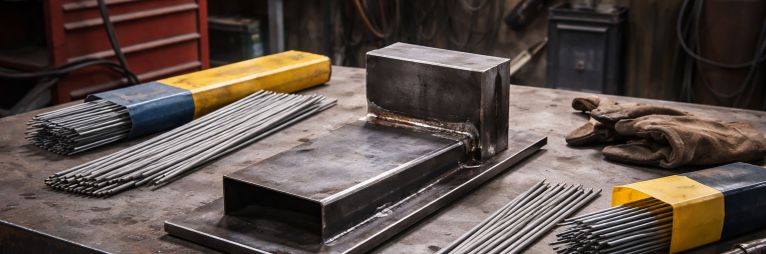
Picking the wrong welding rod can turn your project into a costly mess. You might think all welding rods are the same, but the types of welding rods you choose make a huge difference. This guide breaks down welding rod selection so you can match the right electrodes to your materials and welding techniques, saving time and boosting the quality of your work.
Understanding Welding Rod Basics
Welding rods, also called electrodes, form the backbone of STICK welding operations. These consumable metal sticks create the arc and provide filler material that joins your workpieces. Getting welding rod selection right means understanding how different rods behave with various welding materials and positions.
The coating on your welding rods determines everything from arc stability to penetration depth. Don't settle for whatever's sitting in your workshop. Match your rods to your specific job requirements.
Types of Welding Rods You Need to Know
E6010 Rods
E6010 rods cut through rust, paint, and dirty metal like a hot knife through butter. These cellulose-coated electrodes produce a deep, penetrating arc perfect for pipe work and outdoor construction. The arc runs hot and aggressive, making these rods your go-to choice for vertical and overhead welding positions.
E6011 Rods
Similar to E6010 but designed for AC welding machines, E6011 rods deliver the same aggressive penetration. Choose these when you're working with AC-only equipment or need to weld on contaminated surfaces.
E6013 Rods
E6013 rods offer easier arc control and smoother welds. These all-position electrodes work brilliantly for sheet metal and general fabrication. The slag peels off cleanly, and the arc stays stable even at lower amperages. Perfect for beginners learning proper welding techniques.
E7016 Rods
E7016 rods are a low-hydrogen, medium/high-strength STICK electrode designed for critical structural welding where strength and crack resistance matter. Suitable applications include: structural steel (beams, columns, frameworks), bridges, buildings and infrastructure, pressure vessels and tanks, heavy machinery and mining equipment, shipbuilding and industrial fabrication.
E7018 Rods
E7018 rods are the best welding rods for structural work and code-required projects. The low-hydrogen coating produces strong, crack-resistant welds with minimal spatter. Store these rods in a heated cabinet because moisture ruins them fast. Professional welders rely on E7018 for critical applications where weld integrity matters most.
E7024 Rods
Need to lay down fast, flat welds? E7024 rods deposit metal quickly with a smooth, flat bead. These iron-powder electrodes excel at high-speed production welding on thick materials in the flat and horizontal positions.
Matching Rods to Your Welding Materials
Carbon steel requires different electrodes than stainless steel or cast iron. Study your base metal composition before striking an arc. E6010 and E7018 handle most carbon steel jobs, but specialty welding materials demand specialty rods.
For stainless steel, grab 308 or 316 series electrodes that match your base metal grade. Cast iron needs nickel-based rods to prevent cracking. Aluminium requires TIG or MIG processes because STICK welding aluminium produces poor results.
Key Welding Tips for Rod Selection
Check the position you'll be welding in. Not all welding rods work in all positions. The "1" in E7018 means all-position capability, whilst "2" in E7024 restricts you to flat and horizontal welding.
Match your amperage to rod diameter. Thicker rods need more current. Running too cold causes poor fusion and slag inclusions. Running too hot burns through thin material and creates excessive spatter.
Store low-hydrogen rods properly. E7018 and other low-hydrogen electrodes absorb moisture from the air, causing porosity and cracking. Keep them in a rod oven set between 120°C and 150°C.
Improving Your Welding Efficiency
Stop wasting time with the wrong electrodes. Proper welding rod selection cuts your grinding time in half and reduces weld failures. Stock multiple rod types in your workshop so you're ready for any job.
Buy quality welding rods from reputable suppliers. Cheap electrodes produce inconsistent arcs, excessive spatter, and weak welds. The money you save upfront costs you double in rework and failed inspections.
Practice your welding techniques with different rod types. Each electrode behaves differently. Master the characteristics of E6010's aggressive arc and E7018's smooth, controlled deposition. Understanding how various rods perform makes you a better welder.
Making the Right Choice
Your welding rod selection determines whether your welds pass inspection or end up in the scrap bin. Consider your base metal, welding position, power source, and project requirements before opening a new pack of electrodes.
For structural work, stick with E7018. For dirty or outdoor work, grab E6010 or E6011. For general fabrication and learning, E6013 rods won't let you down. Stock these core types, and you'll handle 90% of common welding jobs.
The best welding rods for your projects are the ones that match your specific needs. Stop guessing and start welding with confidence. Choose the right electrodes, set proper parameters, and produce quality welds every time.
Need Help Choosing Your Welding Electrodes?
Alphaweld is here for you! To speak with our team, give us a call on (08) 9456 8000 or get in touch and our experts will gladly assist you.