

Shop Now
-
Welding Consumables
-
MIG Welding Wire
- Mild Steel MIG Wires
- Stainless Steel MIG Wires
- Duplex & Super Duplex MIG Wires
- Low Alloy MIG Welding Wires
- Flux Cored MIG Wires
- Flux Cored Seamless MIG Wires
- Flux Cored Self Shielded MIG Wires
- Flux Cored Stainless Steel Wires
- Flux Cored Duplex MIG Wires
- Aluminium MIG Wires
- Metal Cored MIG Wire
- Metal Cored Seamless MIG Wires
- Copper Alloy MIG Wires
- TIG Welding Rods
- Welding Electrodes
- Gouging Carbons
- Hardfacing Wires
- Sub Arc Wires
- Sub Arc Flux
- Brazing Rods
- Brazing Fluxes
- Soldering Products
-
MIG Welding Wire
- Welding Torches and Torch Spares
-
Welding Machines
- Machine Bundles
- MIG Welding Machines
- TIG Welding Machines
- STICK Welders
- Multi-Process Welders
- Battery Welders
- Laser Welders
- Laser Cleaners
- Wire Feeders
- Sub Arc Welding Machines
- Stud Welding Machines
- Engine Driven Welding Machines
- Weld Cleaning Machines
- Welding Automation Machines
- Heating Equipment
- Tungsten Grinders
- Tungsten Feeders
- Plasma & Cutting Machines
-
Welding Machine Spare Parts
- Welding Trolleys
- Alfra Spare Parts
- Betaweld Spare Parts
- Bug-O Spare Parts
- Cougartron Spare Parts
- Excision Spare Parts
- Fronius Spare Parts
- Geiger Spare Parts
- Hypertherm Spare Parts
- Kemppi Spare Parts
- Koike Spare Parts
- Lincoln Electric Spare Parts
- Miller Spare Parts
- Neutrix Spare Parts
- Rex Spare Parts
- Taylor Spare Parts
- Unimig Spare Parts
- Von Arx Spare Parts
- Weldmax Spare Parts
- Welding Fume Extraction Equipment
- Gas Welding Equipment
- Welding Abrasives
-
Welding Safety Gear
- Welding Helmets
-
Welding Helmet Spares
- Speedglas Welding Helmet Spares
- 3M Spares
- Betaweld Welding Helmet Spares
- Cigweld Welding Helmet Spares
- Flip Front Helmet Spares
- Jackson Welding Helmet Spares
- Lincoln Welding Helmet Spares
- Miller Welding Helmet Spares
- RPB Welding Helmet Spares
- Servore Welding Helmet Spares
- Unimig Welding Helmet Spares
- Weldclass Welding Helmet Spares
- Miscellaneous Helmet Lens
- Welding Gloves
- Protective Workwear
- Welding Blankets
- Welding Screens and Curtains
- Ear Protection
- Eye Protection
- Face Shields
- Hand Protection
- Head Protection
- Welding Respiratory Gear
- Sun Protection
- Hydration Products
- Fire Blankets
- Prestart Books
- Welding Safety Signages
- Safety Tags
- Hazard Tapes
-
Welding Accessories
- Air Tools
- Power Tools
- Welding Aids
- Welding Tables
- Welding Cables
- Welding Leads
- Electrical Power Supplies
- Welding Clamps
- Clamp Accessories
- Earth Clamps
- Welding Cleaning Equipment
- Welding Chemicals
- Arcair Gouging
- Lifting Accessories
- Hammers
- Manual Arc Accessories
- Weld Measuring
- Weld Testing Products
- Wire Brushes
- Pipe Welding Equipment
-
Cutting & Drilling
- Bandsaws
- Bandsaw Blades
- Bandsaw Accessories
- Cold Saws
- Core Drills
- Cutting Blades
- Diamond Blades
- Drill Bits
- Holesaws
- Magnetic Base Drills
- Metal Working Lubricants
- Pipe Bevelling Machines
- Pipe Cutting Equipment
- Tee Pulling Kits
- Pipe Threading Machines
- Plasma Table Water Additives
- Hydraulic Punching Machines
- Welding Merchandise
- Gift Cards
- Welding Clearances
- Black Friday Deals
-
Welding Equipment Hire
- Hire Equipment
- Hire Heating Equipment
- Hire Degausing Equipment
- Hire Welding Automation
- Hire a Welding Positioner
- Hire a Turning Roll
- Hire a Diesel Welder
- Hire a Wirefeeder
- Hire a Multi-Process Welder
- Hire Welding Accessories
- Hire a MIG Welder
- Hire a TIG Welder
- Hire a Stick Welder
- Hire a Plasma Cutter
- Hire a Weld Cleaner
- Hire a Stud Welder
Can You Use J-B Weld to Repair Aluminium?

Yes, you can use J-B Weld to repair aluminium. J-B Weld is a two-part epoxy adhesive designed to bond metal surfaces, including aluminium. It can be suitable for small cracks, holes and minor repairs where the damaged component is not structural or safety-critical.
However, J-B Weld does not actually weld aluminium. It creates an adhesive bond rather than melting and fusing the metal. For structural repairs, high-stress components and applications requiring a long-lasting metal-to-metal joint, MIG or TIG welding is generally the better solution.
Here's what you need to know before choosing between J-B Weld and aluminium welding.
How Does J-B Weld Work on Aluminium?
J-B Weld Original is a two-part, steel-reinforced epoxy adhesive that bonds to aluminium and other metals. When mixed in equal quantities (1:1), the two components chemically react to form a hard, durable bond.

According to the manufacturer, J-B Weld Original offers:
-
Tensile strength: 5,020 PSI
-
Set time: 4–6 hours
-
Full cure time: 15–24 hours
-
Maximum temperature resistance: Approximately 288°C
Once fully cured, the adhesive can be sanded, drilled, tapped and shaped.
For best results, aluminium surfaces should be thoroughly cleaned, degreased and roughened before applying the epoxy. Always follow the manufacturer's preparation and curing instructions.
J-B Weld can be a practical solution for minor cracks, small holes and non-structural repairs on household items, equipment and other aluminium components.
However, it is important to understand that adhesive strength is not the same as the strength of a properly welded metal joint.
Is J-B Weld as Strong as Aluminium Welding?
No. Although J-B Weld produces a strong adhesive bond, it does not provide the same type of joint as fusion welding.
J-B Weld relies on adhesion between two surfaces, whereas fusion welding melts and joins the aluminium itself, with or without additional filler metal.
The suitability of either method depends on the aluminium alloy, joint design, loading conditions and application. For components exposed to significant mechanical stress, vibration, pressure or repeated temperature changes, an epoxy repair may not provide the reliability required.
Our recommendation: Use J-B Weld for suitable minor, non-structural repairs. For structural components, machinery, pressure-containing parts and safety-critical applications, consult a qualified welding professional about an appropriate repair procedure.
What is Fusion Welding?
Fusion welding joins two pieces of aluminium by creating an electric arc that melts the parent metal. Additional filler material can be introduced to create a strong, continuous joint.
The two most common processes for welding aluminium are:
-
MIG welding (GMAW): A faster, more productive welding process that continuously feeds aluminium filler wire into the weld joint.
-
TIG welding (GTAW): A more precise process that uses a non-consumable tungsten electrode and allows the operator to manually control filler material.
Both processes require suitable shielding gas, typically 100% argon for conventional aluminium welding.
MIG Welding Aluminium
MIG welding is generally the more accessible option for beginners and is particularly suitable for general fabrication, repairs and thicker aluminium materials.
The process uses a continuously fed aluminium wire electrode to create an electric arc, melting the parent metal and filler material together.
For aluminium MIG welding, you will generally need:
-
A MIG welder capable of welding aluminium.
-
Compatible aluminium MIG wire, such as Betaweld XT-5356 Aluminium MIG Wire.
-
100% argon shielding gas.
-
Appropriate aluminium-compatible drive rollers and torch consumables.
A great option for home workshops and general aluminium repairs is the UNIMIG VIPER Multi 185 MIG/TIG/STICK Welder.
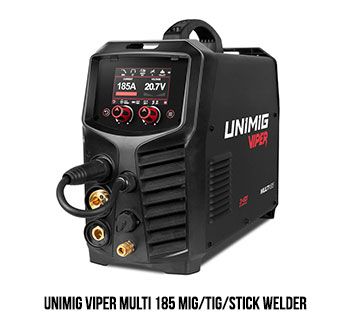
Offering single-pulse MIG technology, synergic welding programs and outputs up to 185A, this versatile machine can weld aluminium, mild steel and stainless steel. Its compact design and standard 10A plug also make it suitable for domestic workshop applications.
For more information, read our guide: Can I Weld Aluminium With a MIG Welder?
TIG Welding Aluminium
TIG welding is the preferred option when precision, weld appearance and control are particularly important.
Unlike MIG welding, TIG uses a non-consumable tungsten electrode to generate the welding arc. Filler material is introduced separately by the operator when required.
One important consideration is that aluminium TIG welding generally requires an AC/DC TIG welder with an AC output.
Aluminium naturally develops a tough oxide layer on its surface. The alternating current provides a cleaning action that helps break up this oxide layer while also providing the heat needed to penetrate the parent material.
A suitable machine is the UNIMIG RAZOR TIG 200 AC/DC Welder.

With AC/DC TIG functionality, adjustable pulse settings and up to 200A output, this machine is designed for welding aluminium, stainless steel, mild steel and other metals.
For beginners, MIG welding is generally easier to learn, while TIG welding offers greater control for intricate repairs and high-quality finishes.
You can also read our guides on TIG welding fundamentals and MIG vs TIG welding.
Should You Use J-B Weld or Weld Aluminium?
The right choice depends on the extent of the damage and the intended application.
J-B Weld is generally suitable for:
-
Minor cracks and small holes in non-structural aluminium items.
-
Household repairs and general DIY applications.
-
Cosmetic repairs where the component is not exposed to significant mechanical loads.
-
Situations where an adhesive repair is appropriate and welding equipment is unavailable.
MIG or TIG welding is generally preferable for:
-
Structural aluminium components.
-
Aluminium boat repairs and fabrication.
-
Machinery and equipment requiring reliable metal-to-metal joints.
-
Components exposed to vibration, mechanical stress or pressure.
-
Repairs where the integrity of the original metal component must be restored.
Remember that J-B Weld products are not rated food-safe, so they should not be used on surfaces that come into direct contact with food.
If you're unsure whether a damaged aluminium component can be safely repaired using epoxy or requires welding, seek advice from a qualified professional.
Need Help Choosing the Right Aluminium Welding Equipment?
Whether you're undertaking a DIY aluminium repair, working on machinery or looking to expand your workshop capabilities, choosing the right welding equipment and consumables makes all the difference.
At Alphaweld Supply Group, we stock an extensive range of MIG welders, AC/DC TIG welders, aluminium welding wires, shielding gases and welding accessories from leading brands.
As WA's leading welding supplies and hire specialist, we're here to help you find the right solution.
Call our team on (08) 9456 8000 or send us an online enquiry for expert advice on aluminium welding equipment and consumables.