

Shop Now
-
Welding Consumables
-
MIG Welding Wires
- Mild Steel MIG Wires
- Stainless Steel MIG Wires
- Duplex & Super Duplex MIG Wires
- Low Alloy MIG Welding Wires
- Flux Cored MIG Wires
- Flux Cored Seamless MIG Wires
- Flux Cored Self Shielded MIG Wires
- Flux Cored Stainless Steel Wires
- Flux Cored Duplex MIG Wires
- Aluminium MIG Wires
- Metal Cored MIG Wire
- Metal Cored Seamless MIG Wires
- Bronze MIG Wires
- TIG Welding Rods
- Welding Electrodes
- Gouging Carbons
- Hardfacing Wires
- Sub Arc Wires
- Sub Arc Flux
- Brazing Rods
- Brazing Fluxes
- Soldering Products
-
MIG Welding Wires
- Welding Torches and Torch Spares
-
Welding Machines
- MIG Welding Machines
- TIG Welding Machines
- STICK Welders
- Multi-Process Welders
- Battery Welders
- Laser Welders
- Laser Cleaners
- Wire Feeders
- Sub Arc Welding Machines
- Stud Welding Machines
- Engine Driven Welding Machines
- Weld Cleaning Machines
- Welding Automation Machines
- Heating Equipment
- Tungsten Grinders
- Tungsten Feeders
- Plasma & Cutting Machines
-
Welding Machine Spare Parts
- Welding Trolleys
- Alfra Spare Parts
- Betaweld Spare Parts
- Bug-O Spare Parts
- Cougartron Spare Parts
- Excision Spare Parts
- Fronius Spare Parts
- Geiger Spare Parts
- Hypertherm Spare Parts
- Kemppi Spare Parts
- Koike Spare Parts
- Lincoln Electric Spare Parts
- Miller Spare Parts
- Neutrix Spare Parts
- Rex Spare Parts
- Taylor Spare Parts
- Unimig Spare Parts
- Von Arx Spare Parts
- Weldmax Spare Parts
- Welding Fume Extraction Equipment
- Gas Welding Equipment
- Welding Abrasives
-
Welding Safety Gear
- Welding Helmets
-
Welding Helmet Spares
- Speedglas Welding Helmet Spares
- 3M Spares
- Betaweld Welding Helmet Spares
- Cigweld Welding Helmet Spares
- Flip Front Helmet Spares
- Jackson Welding Helmet Spares
- Lincoln Welding Helmet Spares
- Miller Welding Helmet Spares
- RPB Welding Helmet Spares
- Servore Welding Helmet Spares
- Unimig Welding Helmet Spares
- Weldclass Welding Helmet Spares
- Miscellaneous Helmet Lens
- Welding Gloves
- Protective Workwear
- Welding Blankets
- Welding Screens and Curtains
- Ear Protection
- Eye Protection
- Face Shields
- Hand Protection
- Head Protection
- Welding Respiratory Gear
- Sun Protection
- Hydration Products
- Fire Blankets
- Prestart Books
- Welding Safety Signages
- Safety Tags
- Hazard Tapes
-
Welding Accessories
- Air Tools
- Power Tools
- Welding Aids
- Welding Tables
- Welding Cables
- Welding Leads
- Electrical Power Supplies
- Welding Clamps
- Clamp Accessories
- Earth Clamps
- Welding Cleaning Equipment
- Welding Chemicals
- Arcair Gouging
- Lifting Accessories
- Hammers
- Manual Arc Accessories
- Weld Measuring
- Weld Testing Products
- Wire Brushes
- Pipe Welding Equipment
-
Cutting & Drilling
- Bandsaws
- Bandsaw Blades
- Bandsaw Accessories
- Cold Saws
- Core Drills
- Cutting Blades
- Diamond Blades
- Drill Bits
- Holesaws
- Magnetic Base Drills
- Metal Working Lubricants
- Pipe Bevelling Machines
- Pipe Cutting Equipment
- Tee Pulling Kits
- Pipe Threading Machines
- Plasma Table Water Additives
- Hydraulic Punching Machines
- Welding Merchandise
- Gift Cards
- Welding Clearances
-
Welding Equipment Hire
- Hire Equipment
- Hire Heating Equipment
- Hire Degausing Equipment
- Hire Welding Automation
- Hire a Welding Positioner
- Hire a Turning Roll
- Hire a Diesel Welder
- Hire a Wirefeeder
- Hire a Multi-Process Welder
- Hire Welding Accessories
- Hire a MIG Welder
- Hire a TIG Welder
- Hire a Stick Welder
- Hire a Plasma Cutter
- Hire a Weld Cleaner
- Hire a Stud Welder
MIG Welding: How to Correctly Set Your Machine Parameters
MIG welding is the easiest arc welding process to master, but the settings on your MIG welder can be a little confusing at first. Incorrect parameters can lead to poor weld quality, lack of penetration, concave welds, undercut, and other weld deformities.
Our guide below will help you understand how each MIG parameter works, its role, and how to set it correctly.
Burn Rate vs. Feed Rate
Before we dive into volts and amps, we should touch on the burn and feed wire rates. Simply put, the MIG wire should be fed at the rate it's burned. Otherwise, the wire could melt back to the contact tip and fuse with it or cause issues with the weld pool if too much wire is fed into it.
Amperage - Wire Feeding Speed (WFS)
The wire feeding speed influences the wire feeding rate and the welding amperage. Unlike TIG or stick machines, MIG welders don't let you modify the amperage output. Instead, you can set the WFS, which duals as an amperage and wire speed setting. So, every MIG power source automatically sets the amperage output for the set WFS.
Amperage determines the amount of current (energy) you input into the metal, which is directly responsible for weld penetration and heat input. So, the thicker the metal, the more amperage you need. Therefore, use a higher WFS for thick and a lower WFS for thin materials.
WFS also determines the filler metal deposition rate. Filling large grooves is easier with a higher WFS, but excessive WFS for the welded thickness can lead to burn-through.
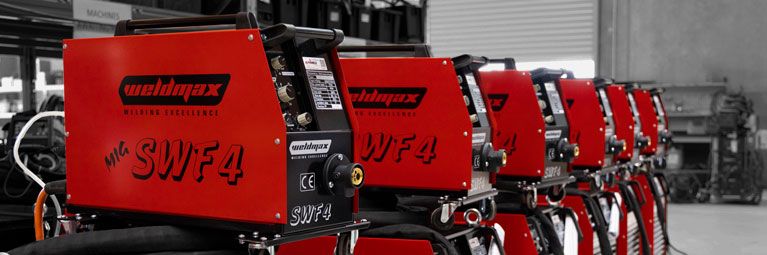
Industrial-grade welders support extra fast WFS for welding thick materials at high deposition rates. For example, the Weldmax 395 SWF has a maximum amperage output of 410A, while its wire feeder supports a WFS of 18m/min.
Voltage
Contrary to popular belief, the voltage does not equal heat when MIG welding; that's the job of the WFS setting. Instead, voltage primarily determines the arc length. Higher voltage produces a long arc, while the low voltage reduces its length.
Arc length is the distance between the weld puddle and the tip of the wire coming from the MIG torch. So, quite literally, increasing the voltage results in your wire burning back further as the distance between the puddle and the wire's tip increases.
Voltage is responsible for the arc's focus. High voltage, or long arc, creates a wider weld bead, while a lower voltage reduces the weld width.
The WFS and voltage must be in balance. Higher WFS settings need a higher voltage and vice versa. Of course, there is a lot of room to micro-manage both to your liking. But, if you were to use a high WFS and a very low voltage, the short arc wouldn't be able to fit all of the wire coming into the weld pool. As a result, you would get a narrow, lumpy weld with a high bead profile. Naturally, most people assume that low heat input is to blame, which is why voltage is sometimes referred to as a "heat" welding parameter. But low voltage doesn't equal low heat. It's just that the arc is too short to spread out the weld bead properly.
However, higher voltage indirectly increases the welding current (heat) after a certain threshold is breached, but that's only the case once the voltage is high enough to significantly reduce the unmelted part of the wire stickout. Since the wire's extension is reduced, so is the resistance to the electrical flow. Therefore, according to Ohm's law, the current increases since your set voltage doesn't change once you start welding.
How To Set Your WFS and Voltage
Most quality welders include an instruction manual to give you a good starting point for WFS and voltage.
Look at the machine's settings chart and find the row that matches your wire diameter, welded metal type, and welded thickness. You'll find a starting point, but it won't always be perfect. Some welding joint configurations can make it challenging to use the settings in the manual. For example, welding two pieces in an edge joint at a 45-degree angle will require some manual adjusting as opposed to a plain butt joint. Typically, when welding edges, corners, or joining two pieces of varying thicknesses, you'll have to adjust the WFS and voltage manually.
Automatic or Synergic MIG Settings
Many modern welders, like the Kemppi MinarcMig 190 Auto, include automatic WFS and voltage adjustment. All you need to do is select the welded material type and its thickness and the wire type and diameter. Of course, you can fine-tune the settings to match the job requirements or use a manual mode for maximum adjustability.
Arc Transfer Modes
The MIG welding process supports several arc transfer modes, but the two most commonly used are the short-circuit and the spray transfer modes. Almost every MIG welder can use both with the right WFS and voltage parameters.
Short-Circuit
The short-circuit is the default MIG welding method. It's widely used, especially for welding thin sheet metals. It has a lower heat input compared to spray transfer but produces more spatter. Use a quality mild steel brush to clean spatter and slag from carbon steel, but don't forget that you need a stainless steel brush for stainless steel and aluminium base metals to prevent carbon contamination. Some filler metal wires can produce less spatter, like the Betaweld ER70S-6 wire, which can reduce post-weld cleaning time and improve productivity.
Short-circuit MIG works by melting the wire's tip as soon as it touches the base metal. The resistance to the flow of electricity melts the wire at the point of contact as it shorts with the metal.
Remember how we said that voltage affects the arc length? That's the length of wire that burns back after the wire shorts with the base metal. Basically, the wire touches the metal, short circuits, and burns upwards toward the torch's tip. The higher the voltage, the longer the arc. If you use excessive voltage, the arc will pull back longer than needed for short-circuit and may become erratic.
Most MIG welder setting charts are designed to put you in a short-circuit transfer mode. So, you won't deviate much from it if you slightly adjust your settings outside the provided range. Use this transfer mode for welding thin steel and stainless steel.
Spray Transfer
The spray transfer is an advanced MIG transfer mode typically used for welding aluminium. But you can use it for steel as well. Spray transfer works at higher currents and voltages. So, you'll need to crank up the WFS and voltage to enter the spray transfer mode.
Increasing the voltage past a certain threshold increases the welding current by reducing the unmelted wire extension. As we discussed earlier, a shorter electrode extension means reduced resistance, which equals a higher current. That's why it's crucial to use high WFS and voltage to enter the spray transfer mode since the high voltage will amplify the amperage from WFS and help the filler wire melt into tiny spray droplets.
Use spray transfer to weld thick steel and aluminium. It will help you weld quickly and achieve deep penetration. In addition, spray transfer doesn't produce much spatter. But, it's challenging to use in the overhead position because the spray transfer produces a very liquid puddle that can easily fall on you. So, it's limited to horizontal and vertical applications only.
Need Additional Help Setting Up Your MIG Machine?
If you need help in choosing a suitable MIG welder or figuring out how to set it up, Alphaweld is here for you. To speak with our team of experts, give us a call on (08) 9456 8000 or contact us and our experts will gladly assist you.